
Women in Science: Dounia combines scientific knowldedge with business insights
In our Women in Science series, we highlight the women working in science, technology, engineering and mathematics (STEM) at EnergyVille. Through their personal stories, we explore what brought them into their fields, what it’s like to work in research, and the opportunities and challenges they encounter along the way.
From a PhD in chemistry to consultancy and now a role at imec, Dounia Saadallah (EnergyVille/imec) has built a career by combining scientific knowledge with business insight. In this Women in Science article, we talk to her about the subtle barriers women can face at work, the importance of believing in yourself and why the energy transition deserves greater priority.
From a PhD in chemistry to the energy transition
Dounia Saadallah’s career has taken her from the chemistry lab to consultancy and, ultimately, to the energy sector. Today, she works at imec as portfolio manager for energy and environment, a role that also brings her into contact with the research taking place at EnergyVille.
Her journey began with a PhD in chemistry. Although she enjoyed the scientific thinking and writing involved in her doctorate, she soon realised that spending years doing lab work was not what she wanted for her future.
Dounia: "But rather than leaving my scientific background behind, I looked for a way to use it differently. I switched to consultancy, helping companies secure grants for research and innovation projects. Over nine years, I grew into a role that combined market strategy, team management and involvement in large-scale funding projects."
ㅤ
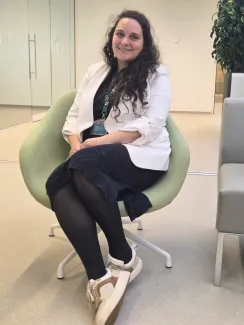
"That experience gave me something I had not developed during my scientific training", Dounia continues. "A strong understanding of the financial and business dimensions of innovation."
“It’s an interesting combination: having a scientific background while also understanding the financial aspects, how to build a business plan and how to look at market trends.”
After nearly a decade in consultancy, Dounia was ready for a new challenge. An opportunity at imec spoke to her because it brought together the different skills she had developed and allowed her to work on a subject she increasingly cared about: the energy transition. And that's how she was introduced to EnergyVille.
For Dounia, the appeal is clear: "The energy transition is one of the major challenges society faces, and contributing to solutions is what makes the sector fascinating.
Careers in STEM don't have to follow a straight line
Dounia has been interested in science for as long as she can remember. Her uncle was a physicist, and she eagerly took every opportunity she got to ask him questions. At school, science subjects came naturally to her, largely because she was genuinely interested in them.
Dounia: "Choosing chemistry felt like an obvious next step. At the time, I imagined working in the pharmaceutical sector, but my interests evolved as I gained experience. Eventually, the energy sector proved more compelling."
"A career in STEM does not have to follow a straight line. A scientific education can open doors to many different roles, including ones that combine technology, strategy and business."
Equality vs equity
When it comes to being a woman in a male-dominated environment, Dounia says she did not think about gender much during her studies. Although there were relatively few women in her classes, she had several influential female teachers and did not feel that being a woman defined her experience.
It was only, later in her professional life, that she began to notice a difference. “I think it was often very subtle. It was never anything obvious", Dounia explains. "It was always small things that you think aren’t that bad. But when you add them up, you start to see a trend. I started to notice that some of my male colleagues got more opportunities than I did, and couldn't help but wonder if this was because of my gender.”
"Maybe the real issue is that addressing inequality does not necessarily mean treating everyone in exactly the same way", Dounia says. "Maybe it also means recognising that people may approach opportunities differently, and ensuring that they receive the support they need to progress."
Don't be too humble
Her advice to girls and young women considering a STEM education is straightforward:
“Don’t be too humble. If you want it, go for it.”
"You don't have to be the loudest person in the room to have valuable ideas or the skills to succeed", says Dounia. "Nor should uncertainty automatically be interpreted as a sign that you're not ready."
Dounia's career clearly shows that there is no single way to build a future in STEM. Scientific knowledge can be a starting point for research, business development, strategy or many other roles. Sometimes, finding the right path means moving beyond the work you initially imagined doing.
Building a better energy future
Today, Dounia is excited to contribute to the energy sector.
For her, the challenge calls for long-term perspective. The decisions made today will shape the world people live in ten or fifteen years from now, including the world their children inherit.
Dounia: "I'm optimistic about the potential of technologies such as nuclear fusion, but I'm very much aware that no single technology will provide all the answers. I think the future will depend on a combination of solutions, including batteries and other technologies working together as part of an interconnected energy system."
"Ultimately, I hope that decision-makers take a more ambitious, long-term approach to the energy transition. The benefits of acting today may not always be immediate, but the consequences of delaying action will be felt well into the future."
A question for the next woman in science
In our previous article, Marina Vitali asked Dounia a simple but meaningful question: “Do you feel at home here?”
Dounia's response is rather careful: "I've only been at EnergyVille for six months, so it's still too early to give a definite yes. However, my first impression is positive. I appreciate the facilities, the pleasant working environment and the people, and I can definitely imagine feeling at home here."
Now, it's Dounia’s turn to pass a question on to the next woman in science:
“Who has inspired you most in your career?”
In our next article, we’ll discover who has shaped Jessica de Wild's (EnergyVille/imec) journey and what we can learn from the people who inspire women working in science and technology.