
Women in Science: Marina Vitali on looking beyond the engineering stereotypes
In our Women in Science series, we highlight the women working in science, technology, engineering and mathematics (STEM) at EnergyVille. Through their personal stories, we explore what brought them into their fields, what it’s like to work in research, and the opportunities and challenges they encounter along the way.
First up: Marina Vitali, a PhD researcher in power electronics at EnergyVille/KU Leuven. Originally from Italy, she moved abroad to pursue her research ambitions. Her message to women and girls considering a career in STEM? Keep an open mind: engineering offers far more possibilities than you might think.
Find your own path in engineering
Marina is originally from the region around Venice, Italy. “The region with the good Aperol Spritzes”, she laughs.
After studying energy engineering for her bachelor's degree and electrical engineering for her master's degree, she moved to Germany to complete her master's thesis at ABB's research centre. Today, she is pursuing her PhD in power electronics at EnergyVille/KU Leuven, where she is in her second year of research.
“Traveling internationally for my studies was a conscious choice”, Marina says. “I knew I wanted to pursue a PhD, but I also wanted to experience a different university environment. I began exploring opportunities abroad and eventually connected with a researcher on LinkedIn, who helped me find my way to Belgium. I didn’t have one specific destination in mind, I just wanted to try something different and explore other countries.”
ㅤ
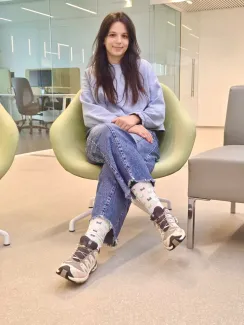
That willingness to explore has also shaped her academic interests. Marina initially chose the broader field of energy engineering, with an interest in areas such as renewable energy, wind and solar power, before moving towards electrical engineering and power electronics.
Marina: “My current research focuses on solid-state transformers and new converter topologies that could make the conversion of electrical energy more efficient and reduce the amount of material required. In particular, I am investigating technologies that convert medium-voltage alternating current (AC) into low-voltage direct current (DC), helping bridge the gap between electricity distribution networks and the power needed by electronic devices.”
“It’s a specialised field, but one with a clear connection to everyday life. How can we deliver electricity more efficiently, using less material and making better use of the systems that supply our energy? How can we make sure that, on streets where more and more people install solar panels, charge electric cars, or switch to heat pumps, the local grid can still keep up? How do we prevent grid congestion, delays in getting a new connection, or even outages? That’s endlessly fascinating to me.”
Engineering is more than its stereotypes
For Marina, one of the most important messages she would share with young people considering a career in STEM is that engineering is much broader than it is often portrayed.
“When you think about engineering, the first thing that often comes to mind is mechanical engineering. You might think about motors, cars or buildings. But it is actually a much broader spectrum.”
“That narrow image can make it harder for young people to picture themselves in the field, particularly if they have little contact with engineers or researchers”, Marina tells us. I was fortunate to have a father who also worked in engineering, giving me an early introduction into the profession. Not everyone has that advantage.”
“At school, the options presented to students who are interested in science can sometimes seem limited. But engineering encompasses a wide range of disciplines, from energy and electrical systems to management engineering and many other specialisations. It’s worth looking into all of those before deciding.”
Marina’s own career path illustrates how interests can evolve over time. Starting with energy engineering did not prevent her from moving into electrical engineering later on. Exploring one subject helped her discover another that suits her even better.
“Just know that there are options, the field of engineering is much broader than mechanical or civil engineering”, Marina says. “Give yourself room to discover what interests you. You don’t need to know exactly where you will end up when you start your studies.”
Being a woman in a male-dominated field
Electrical engineering and power electronics are fields in which women remain underrepresented. Yet Marina's own experience shows why it’s important to look beyond statistics and assumptions when talking about women in science.
Marina: “Within my research team, gender is not something I particularly notice in my day-to-day work. The team has different areas of expertise, and the colleagues can turn to one another for feedback and support.”
“I must admit, though, that sometimes when I’m at a conference and I’m the only woman, I do wonder whether someone is networking with me because they’re interested in my ideas, or because they just want to talk to a woman."
What will the future bring?
With more than two years of PhD research still ahead of her, Marina is not yet ready to decide what comes next. She is considering both academic research and industry, and could imagine a role somewhere between the two. Whether she stays in Belgium is also an open question.
“For now”, she says, “I’m focused on making the most of the research opportunities in front of me and discovering where they might lead. I don’t believe you need to have every step mapped out from the beginning. Interests can change, new opportunities can emerge, and one field can lead unexpectedly to another.”
A question for the next woman in science
Marina’s own journey is still unfolding, and she’s curious to hear how other women at EnergyVille experience their work and environment. For the next interview in our Women in Science series, she has a question for Dounia Saadallah (EnergyVille/imec): “Do you feel at home here?”
In our next article, we’ll find out how Dounia answers Marina’s question and discover the story behind her journey in science and technology.