
A DC-DC converter as small as a smartphone
What if a DC-DC converter, today approximately the size of a crate of beer, could become as compact as a smartphone? That's what Hans Wouters (EnergyVille/KU Leuven) wondered during the final phase of his PhD. A few months later, he developed a new transformer architecture that makes this possible. The technology not only makes power electronics more compact but also opens up new possibilities for applications in, among others, electric vehicles and data centres.
A DC-DC converter is an electronic device that converts direct current (DC) to another direct current voltage. It can, for example, reduce a higher voltage or increase a lower voltage. DC-DC converters ensure that electrical systems with different voltage levels can work together efficiently.
The research into DC-DC converters is part of EnergyVille’s Homelab.
Hans studied industrial engineering in electromechanics in Diepenbeek and worked for a year and a half at Magcam, an imec spin-off, after his studies. Yet, the idea of pursuing a PhD continued to appeal to him. Through his master's thesis, he came into contact with Professor Wilmar Martinez (EnergyVille/KU Leuven).
"There was an immediate connection," Hans says. "What particularly appealed to me was the freedom to try out new ideas. During my doctorate, I was given a lot of space to even test what might seem like crazy ideas."
That freedom proved crucial. Hans focused on power electronics for electric vehicles, specifically on DC-DC converters. One of the biggest challenges in such converters is the transformer, a component that traditionally takes up a lot of space.
Not just a bit smaller, but fundamentally different
In the engineering world, innovation often revolves around incremental improvements. A component becomes slightly more efficient, slightly lighter, or slightly cheaper. Hans consciously wanted to look further.
"As an academic researcher, you have the opportunity to search for ideas with a bigger impact. Companies like Tesla or Volkswagen have much larger budgets. We can strive to develop fundamentally new concepts."
Thus, the idea arose not to simply optimise an existing transformer, but to look at the design in an entirely different way. The starting point was surprisingly simple: how do you make a transformer not only smaller but significantly more flat?
This led to a new PCB-based transformer architecture (using flat copper traces as windings on the layers of a circuit board instead of traditional copper wires) where the copper traces are guided through the circuit board in a specific way. Thanks to so-called snake windings, many more windings can be realised without adding extra copper layers.
Hans explains: "Normally, you always encounter a compromise. More windings usually mean more complexity or a larger design. With this architecture, it’s quite the opposite. The more windings we add, the more compact the pattern becomes, resulting in very flat transformers."
While conventional PCB transformers are difficult to scale up to a large number of windings, the new architecture allows a very large number of windings to be realised with just four PCB layers. This reduces the magnetic flux and makes it possible to execute the entire transformer exceptionally thin.
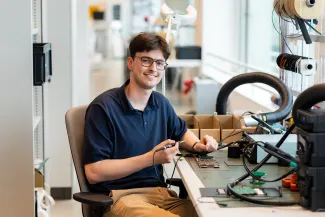
Eureka moment, or perhaps not?
"You work on the same problem for years," Hans explains. "You constantly try to come up with solutions, and just as often they prove not to work. Eventually, this idea came to me one evening when I was sketching on my iPad. The potential was clear, but as always with new ideas, I remained skeptical."
"The real thrill came much later when the prototype actually worked in the lab. That was the moment I thought: yes, we did it."
The decision to focus on miniaturising DC-DC converters was not without risk. While his doctorate was nearly completed, Hans decided to set aside a significant portion of his earlier research and fully commit to this new concept.
"I essentially had everything I needed to complete my doctorate. But this idea had much more potential. So I decided to go all in and build one prototype. If that didn't work, I essentially had nothing."
Why smaller is important
A more compact DC-DC converter doesn't automatically mean that an electric car can suddenly travel hundreds of kilometres further. According to Hans, the biggest gain lies elsewhere.
"Of course, you save space and weight in a vehicle. That makes it easier to integrate all components and gives designers more freedom. More compact drivetrains remain an important goal within the automotive sector. Furthermore, my design is especially easy to assemble automatically and uses inexpensive manufacturing techniques."
And beyond the automotive world?
Hans: "Besides the automotive sector, data centres might be the most interesting application for the miniaturised DC-DC converter. The power requirements of modern AI chips are increasing incredibly quickly. This energy needs to be converted efficiently from hundreds of volts to a fraction of a volt."
Today, this is done in multiple steps, and very inefficiently. By making transformers much more compact and flat, they can be placed closer to or even under the chips, significantly reducing energy losses.
"That's where this technology can really make a difference. Not only because everything becomes more compact, but because it enables applications that are difficult to achieve today."
Research begins where answers don't yet exist
According to Hans, that's exactly where the strength of academic research lies.
"In the automotive world, new technologies are introduced cautiously. With AI and data centres, the challenges are much more fundamental. Nobody knows exactly how we will supply the next generation of chips with enough energy. That's what makes it such an interesting research domain."
Meanwhile, a patent application has been filed for the technology. For Hans, that's a nice next step, but not the end.
"Research means continually discovering new problems. Every solution brings new challenges. And that's what makes it so fascinating."