
Yami Chuang is working towards more sustainable chemistry
Yami Chuang combines two roles. At imec, she is a programme manager; within EnergyVille, she helps coordinate the Power-to-Molecules research line. In that role, she works at the intersection of materials, electrochemistry and system integration, with a focus on converting CO2 via renewable energy into carbon-based molecules such as syngas, as well as other more
sustainable chemical building blocks.
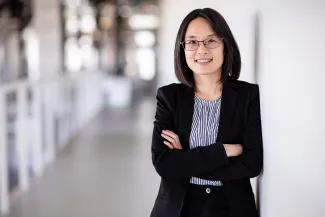
Yami grew up in Taiwan, moved to Australia to study, and later continued her academic career in Belgium. She first did a postdoc at UHasselt, then moved into industry as an R&D manager, before returning to research. Joining imec felt like a logical next step: she wanted to help develop cleaner industrial processes and technologies.
“The energy transition is too complex to be driven by one group or one technology alone,” she says. “You need to bring expertise together with industry and government.” That is what makes EnergyVille so valuable to her: the combination of complementary knowledge, years of collaboration and an ecosystem that is grounded in real industrial and policy challenges.
A highlight in 2025 was the further development of MiniChem Plant, an initiative designed to help companies evaluate promising technologies more quickly and with greater confidence. “Many industrial partners know they need to innovate, but often lack a clear way to test new materials, devices or system configurations before investing in them.” MiniChem Plant addresses that gap by bringing together modelling, testing and system-level analysis
in one flexible platform.
“There are two ways to innovate: we can develop a technology, bring the pieces together and let companies use it in different scenarios, or we can start from a concrete condition or industrial target and ask what would actually work. That is how we can help shorten the path to application while keeping it economically viable.”