
Thermal storage
Thermal energy storage is a key part of EnergyVille’s research. It enables surplus heat or cold to be stored and used when needed, decoupling energy supply from demand. This helps address the daily imbalance between household heat demand and the availability of renewable heat sources, such as solar collectors and PV-coupled heat pumps.
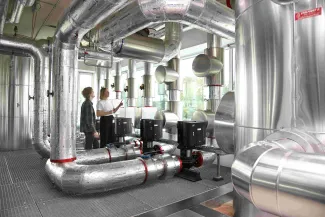
A wide range of thermal storage technologies is available, from conventional water tanks to advanced solutions such as Phase Change Materials (PCM) and thermochemical storage.
Depending on the application, heat or cold can be stored for different periods:
-
A few hours or days, for example in domestic hot water buffers
-
An entire season, for example through underground borehole thermal energy storage
In addition to balancing supply and demand, thermal storage increases operational flexibility and improves the overall efficiency of energy systems.
Linking Thermal and Electrical Grids
Thermal storage also plays an important role in connecting thermal and electrical energy systems. Integration with the electricity grid requires conversion technologies such as heat pumps or Organic Rankine Cycles (ORCs). Within thermal networks, storage balances energy production, conversion systems and demand, both in the short term (day-night) and the long term (winter-summer).
Research at EnergyVille
At EnergyVille, we research the development, demonstration and implementation of:
-
Compact thermal energy storage based on Phase Change Materials (PCM)
-
Medium- and high-temperature thermal storage for industrial applications using optimised packed-bed technology