
Tandem Solar Cells
Tandem solar cells combine two or more solar cells with complementary material properties into a single device. By stacking these cells in a tandem configuration, a larger portion of the solar spectrum can be converted into electrical energy.
This approach makes it possible to overcome the physical limitations of individual solar cell technologies and achieve higher conversion efficiencies.
Unlocking Higher Energy Conversion Efficiencies
A well-known example is the combination of a perovskite top cell with a silicon bottom cell. Each cell captures a different part of the solar spectrum, allowing the tandem device to generate more energy from the same amount of sunlight.
At EnergyVille, we aim to achieve tandem energy conversion efficiencies of more than 30%. This exceeds the theoretical efficiency limit of approximately 28% for conventional silicon solar cells.
Developing Stable and Scalable Tandem Technologies
To reach these performance levels, we investigate a wide range of material combinations, manufacturing processes and device architectures. Our research includes different contact configurations, such as 2-terminal and 4-terminal tandem cells, with a strong focus on stability, reliability and scalability.
From Research to Large-Area Demonstration
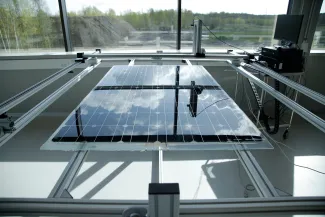
In addition to developing new tandem concepts, we work on scaling them up to larger formats. We develop and demonstrate stable tandem configurations in industrially relevant formats, including M2-sized devices and modules up to 30 × 30 cm. By combining high efficiency with large-area manufacturability, we help pave the way for the next generation of photovoltaic technologies.