
Providing direction for policy: PATHS2050
Pieter Lodewijks of EnergyVille/VITO explains why PATHS2050 is about more than scenarios alone. By bringing industry, infrastructure players and energy companies into a single modelling exercise, the coalition aims to broaden and strengthen the energy debate. “We have been working on the models behind these scenarios for more than 25 years,” he says. “We have developed scenarios for Belgium, for Flanders, and, at times, at European level. Usually, we do this work for governments, federations or companies. It is fascinating work, but we also saw the limitations: if you work with one party, you often only get one side of the story.”
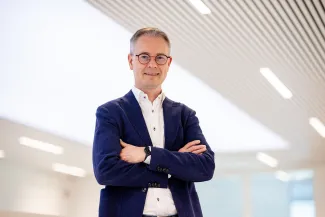
That insight helped inspire the PATHS2050 Coalition. Instead of working with stakeholders separately, EnergyVille brought together industrial users, energy producers, and infrastructure and grid operators.
“We thought: what if we bring together different stakeholders, each with their own perspective on the future of the energy system, and ask them to shape scenarios together?” says Lodewijks. “You do not just get a richer debate; you also get scenarios that keep the whole system in view.”
He is convinced that this approach has had a major impact on the quality of the work. “The partners really challenge each other,” he says. “Everyone comes in with their own background and sensitivities, of course. BASF looks differently at carbon capture and storage than a grid operator does. Fluxys has a different view of the role of gas than someone reasoning mainly from electrification. And when it comes to nuclear, you can expect equally strong discussions. But that tension is what makes the process so valuable. At EnergyVille, we try to act as a neutral moderator and provide the quantitative framework.”
That process led to the publication of the Main Edition 2025, which develops three different scenarios in depth. For Lodewijks, the real added value lies in the themes that return across all of them. “There are several common threads across the three scenarios—we sometimes call them no-regret measures,” he says. “The most important one is electrification. Whichever path you choose, if you want to get to net zero, electricity use will at least double. At the same time, total energy demand falls by a third or more.”
He believes this is one of the most underestimated insights in the latest analyses. “Many people still assume that more electricity automatically means more energy use overall. But that is not true. With heat pumps, electric vehicles and more efficient processes, you ultimately need less energy. Electrification does not just increase electricity demand; it is also a major efficiency gain, and it makes us less dependent on imported fossil fuels.” A second key conclusion is that Belgium will have to produce much more electricity. Offshore wind and solar power feature prominently here. “What really strikes me,” says Lodewijks, “is the scale of what we need to do. In the case of solar energy, this means repeating our best year on record over and over again, every year for years to come.”
That finding gives the policy debate real urgency. “Governments obviously have their own energy and climate plans,” he says. “But what you often see is a fairly linear continuation of what is already happening today. That is not an energy transition. If you want to reach net zero, you have to move faster, and in some areas, much faster.”
Offshore wind is a good example of the gap between what makes sense in a model and what happens in practice.
“In our models, additional offshore wind is a very logical building block,” he says. “But in reality, you see delays, political shifts, and uncertainty. That is why we decided to dedicate a separate deep dive to this issue. It shows that delays do not just affect emissions, because gas-fired power plants have to fill the gap. They also temporarily push up the energy bill by 4 to 7%.”
One important point is that the broad conclusions of PATHS2050 hold even when assumptions change. “That is what we mean by robustness,” Lodewijks says. “Of course, you can adjust assumptions about renewables, nuclear energy, or carbon capture and storage. But if the main message still holds, that tells you something. It shows that certain directions remain fundamental, even when the boundary conditions shift.”
He also sees a clear role for EnergyVille in that process. “Many teams within EnergyVille work on technologies - batteries, thermal networks, grids, flexibility, hydrogen, and more. With our energy models, we try to bring those insights together at system level. What does a breakthrough in battery technology mean in the wider energy context? What rolecan thermal networks play? What changes if CO2 storage is available, or when it’s not?”
The impact of PATHS2050 can be felt on several levels: “We organise public events and engage with ministerial cabinets and government administrations, both in Flanders and in Wallonia, where we explain our results in detail.” Those conversations, he says, go well beyond the scenario outputs themselves. “It is not just about what comes out of a model, but also about how you translate that into policy: renovation policy, heat pumps, tax shifts between electricity and gas, infrastructure choices. We actively contribute to those discussions as well.”
He also sees that the work is resonating in the way specific analyses are being picked up. “Our deepdive paper on offshore wind delays was discussed in parliament,” he says. “That is when you realise a study is really shaping the debate. Of course, it helps that the message is not only coming from us, but from a broad coalition of companies and partners.” It is one of the major strengths of the PATHS0250 approach, he says. “If a research institution makes a statement, that is one thing. But if you bring together players from across the entire energy system, the message carries much more weight.”
If there is one conclusion he would want policymakers to take away from the 2025 PATHS2050 results, it is the urgency of making system-level choices now.
“We need to scale now,” he says. “That is the essence for me. We should not get stuck on one technology or idea, but understand that certain choices keep returning in every scenario: electrification, increased electricity production, renovation, offshore wind, infrastructure. If you postpone those, you make the whole system more expensive and more difficult.”
Importantly, PATHS2050 is not trying to prove that there is only one correct route. “There are different pathways to climate neutrality,” he says, “but none of them allows us to do nothing. That may be the most important message of all.”
What is PATHS2050?
PATHS2050 is EnergyVille’s scenario and modelling work on how Belgium can become climate-neutral by 2050 without losing sight of economic resilience. Since 2022, more than 200 researchers have worked on datadriven scenarios for the Belgian energy system. EnergyVille/VITO joined forces with nine leading industrial and energy companies in the PATHS2050 Coalition: ArcelorMittal, BASF, Elia, Engie, Fluxys, Holcim, Luminus, Otary and SCK CEN. The coalition shares ideas and know-how to jointly evaluate possible transition pathways.
Main edition 2025
In 2025, the PATHS2050 Coalition presented its new results in the Main Edition 2025. The report develops three possible routes towards climate neutrality in Belgium: ROTORS, a scenario with a strong focus on renewable energy; REACTORS, where nuclear capacity plays a larger role; and IMPORTS, which relies more heavily on imported molecules and electricity. The study explores how Belgium’s energy system could move towards net-zero CO2 within each of these pathways, and which choices matter most for policy, industry, and infrastructure.
Despite the differences in approach, the three scenarios share certain common conclusions. In each scenario, final energy demand falls by around one-third by 2050, while electricity consumption more than doubles. Electrification of buildings, transport and, later, industry proves essential in every scenario, as does a major expansion of wind and solar energy, new nuclear capacity where permitted, additional infrastructure, and CO2 storage for industrial activities that are hard to decarbonise. Clean molecules complement the energy mix and remain essential for international transport and for industrial processes where electrification is not a realistic option.