Demo-BLog shows how Digital Building Logbooks can accelerate renovation, decarbonisation and circularity
Digital Building Logbooks help unlock the building data needed for a more sustainable built environment. In Demo-BLog, we develop digital algorithms and data-driven services that aggregate relevant building data, enable authorised access and new services, and safeguard building owners’ privacy through the SOLID approach.
Watch the Demo-BLog project introduction video
Turning fragmented building data into action
Digitalisation and data-driven services in the construction sector are necessary to improve the overall sustainability of the built environment and meet our climate goals.
Demo-BLog demonstrates how Digital Building Logbooks can capture, integrate and store building data, and convert this data into actionable information for relevant stakeholders across the construction market value chain.
The current construction market, more specifically the renovation market, is traditionally fragmented and lacks a clustered approach. This fragmentation slows down the transition towards a sustainable built environment and makes it harder to achieve the renovation wave. Demo-BLog addresses this challenge by connecting building data, digital tools and stakeholders across the renovation value chain.
Digital Building Logbooks for smarter renovation and zero-energy districts
Local energy transition initiatives, driven by governments, (social) housing associations or energy communities need proper tools to develop neighbourhood-based approaches to integrate renewable and digital solutions and create zero-energy districts, where consumers become prosumers selling energy to the grid.
Efficient use of new and existing data sources effectively managed and accessed via Digital Building Logbooks, can improve resource efficiency, planning and targeted incentives to benefit local governments, the construction sector, financing institutions, homeowners and tenants.
Four Demo-BLog functionalities for a sustainable built environment
Demo-BLog brings together five front-runner Digital Building Logbooks with a wide variety of target groups, demonstrating four key functionalities addressing societal challenges:
1. User-centric automated renovation advice;
2. Decarbonisation roadmaps at building level;
3. Platform for community driven decarbonisation projects;
4. Multi-cycle circularity approaches, fostering a marketplace for construction materials reuse.
A new organisational model for Digital Building Logbooks
To support wider implementation, VITO/EnergyVille has developed an Organisational Model for Digital Building Logbooks (DBL) within Demo-BLog. The model clarifies roles, responsibilities and data flows across EU, national and provider levels. It supports coordination within a federated DBL ecosystem and helps create the conditions for harmonised implementation, while respecting national subsidiarity and data sovereignty.
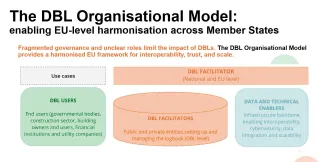
The Organisational Model for Digital Building Logbooks (DBL) shows how DBL users, facilitators, and data and technical enablers can work together across EU, national and provider levels.
The model brings together DBL users, DBL facilitators, and data and technical enablers. By mapping how these actors interact, it helps strengthen interoperability, trust and scalable data sharing across Europe’s built environment.
To translate this governance framework into practice, VITO/EnergyVille identifies five priority actions for EU Member States and DBL stakeholders: establish an EU-wide governance framework, use national DBL portals as implementation hubs, strengthen technical and legal foundations, drive adoption through mandates and incentives, and develop a participatory organisational model that keeps stakeholders actively involved.
Read the full report: The Digital Building Logbook Organisational Model
VITO/EnergyVille’s role in Demo-BLog
VITO/EnergyVille activities include:
1. Develop KPIs for circularity on different levels (material, component, building);
2. Define evaluation criteria to test benefits of using circularity functionality at DBL level;
3. Explore data acquisition, handling and digitalisation of materials and building components, covering their life cycle impacts and multi-cycle circularity potentials;
4. Execute circular environmental impact assessments as an evaluation criterion;
5. Strengthen expertise and knowledge on the decarbonisation of the built environment from a community driven approach;
6. Develop the policy and business exploitation potential of the concept of the Digital Building Logbook;
7. Develop and test a toolchain in which public data in the digital logbook (e.g. EPC data) is combined with private external data (e.g. actual energy consumption profiles). SOLID data pods will be deployed for secure data management. Existing VITO tools (notably EBECS) will be part of this toolchain, as trusted external tool to enhance the data quality and provide tailor made renovation advice.
Discover Demo-BLog
More info
Would you like to know more about Demo-BLog? Contact Steven.