Noak, a new spin-off of imec and Hasselt University, raises €5 million to industrialize next-generation perovskite–silicon tandem solar technology
Noak, a new spin-off of imec and UHasselt within EnergyVille, has raised €5 million to scale and industrialize the development of the next generation of solar: perovskite–silicon tandem PV. The seed investment, provided by the Helios Foundation, Nuhma and V2HFin, marks an important next step in bringing this promising technology closer to European manufacturing.

Solar photovoltaics (PV) have become the fastest-growing renewable energy source, driven by rapidly falling technology costs. Yet despite Europe’s historic leadership in PV research, the continent manufactures a negligible fraction of the solar capacity it installs each year. This imbalance has created a structural dependency on imported PV technologies.
Reaching global climate targets requires an extraordinary expansion of solar PV to approximately 50 terawatts by 2050, and potentially 100 terawatts by the end of the century from the currently installed 3 terawatts. The question is no longer whether solar PV will scale. The challenge is enabling that scale with the highest possible efficiency and resource productivity.
At the same time, conventional silicon-based solar cells are steadily approaching their efficiency limits. Conventional silicon technology has driven impressive solar growth until today, but it is approaching its practical energy conversion efficiency limit of around 27-28%.
Breaking the silicon efficiency ceiling
Perovskite-based tandem solar technologies are well positioned to address these challenges. When paired with silicon in a tandem cell configuration, perovskites can harness a broader portion of the solar spectrum, offering conversion efficiencies of 30 - 35%.
Noak, a start-up based on imec’s and UHasselt’s IP portfolio on perovskite-silicon tandem technology, builds on this potential. At the core lies a high-performance perovskite layer stack, developed through proprietary chemical compositions and scalable deposition techniques. The technology is underpinned by more than a decade of research within IUMAT (the Institute for Materials Research of UHasselt and imec) and within the framework of EnergyVille.
Long-term stability
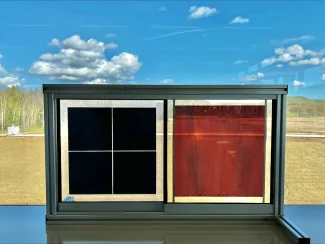
Long-term stability under real-world conditions is a key challenge for perovskite-silicon tandem technology. While most stability claims rely on accelerated laboratory testing, imec and UHasselt have accumulated five years of outdoor operation across over 10 test sites on three continents, withstanding intense sunlight, heavy rain, extreme heat, and sub-zero temperatures across Asia, Europe and North America. This extensive real-world dataset provides a strong foundation for Noak. Building on it, the next phase will focus on demonstrating long-term stability and performance at scale, key requirements for bankability and commercial success.
Designed for circularity and resilience
Complementing the tandem cell architecture is Noak’s proprietary 3D woven back-contact foil, which integrates the electrical connections at the rear of the cell. This eliminates the need for front-side metallization, reducing shading losses while supporting more efficient material use and easier recycling at the end of the module’s life.
Furthermore, Noak’s tandem can be subdivided into smaller sub-cells connected in series and parallel, allowing for design flexibility and enabling reductions in metal usage. The 3D foil and tile architecture make it possible to drastically reduce the use of expensive and rare metals. These innovations address both cost and critical raw material dependency, key concerns for future solar scalability.
Noak embeds circularity in every new cell architecture, guided by the core principles of design for disassembly and debonding on demand. To translate this vision into practice, Noak partners with its supply chain to work towards the use of certified recycled metals, ensuring that sustainability is embedded from its very first commercial products. Noak’s platform aims to create regional industrial resilience by lowering critical material usage by its novel cell and module architecture.
The €5 million investment from the Helios Foundation, Nuhma and V2HFin will now be used to accelerate development using the existing infrastructure at EnergyVille in Genk and to prepare scaling with gigawatt manufacturing partnerships.



About Helios Foundation
Helios Foundation is a Belgian foundation dedicated to accelerating solutions for two of the country’s major challenges: climate change and the well-being of the workforce. Through strategic funding, partnerships and support for innovative solutions, Helios aims to act as a catalyst for Belgium’s transition towards carbon neutrality. The Foundation brings together academia, industry, policymakers and other stakeholders to turn promising ideas into concrete, lasting impact.
About Nuhma and V2HFin
Nuhma is the climate investment company of Limburg municipalities. Since 2000, Nuhma has a strong track record of investments in next-generation renewable energy, smart-grid technologies and innovative solutions that contribute to the energy transition. As an active cooperative investment holding, Nuhma combines sustainable investments with long-term value creation for the region and its communities, helping to build a sustainable and smart energy future for Limburg and beyond.
V2HFin is a wholly owned subsidiary of Flemish Energy Holding (VEH). It acts as an investor to support the growth of Flemish start-ups and scale-ups, with the aim of accelerating the transformation of the energy sector and driving progress in sustainability and innovation.
About imec
Imec is a global R&D center for advanced semiconductor technologies. Through its R&D collaborations, venturing activities and design & manufacturing capabilities, imec builds the hardware for tomorrow’s AI-driven era. The unique combination of its state-of-the-art R&D infrastructure, the largest semiconductor ecosystem and top talent of 6,500 employees, powers breakthroughs across a wide range of industries, including computing, connectivity, health, automotive, industry, consumer electronics, aerospace and security. Imec brings global technology leaders, start-ups, academia, and research institutions together on common ground to tackle technology challenges that no single company can solve alone. Headquartered in Leuven, Belgium, imec has research facilities in Belgium, across Europe, the USA, Japan and the GCC region, and representation in Taiwan, Korea and India.
About UHasselt
Hasselt University is a dynamic, research-driven university with a strong focus on innovation, entrepreneurship and societal impact. Its research in sustainable energy, including next-generation photovoltaic technologies, is carried out within the EnergyVille ecosystem and contributes to the development of more efficient, reliable and integrated solar solutions.
About EnergyVille
EnergyVille is a leading Belgian energy research and innovation hub based at Thor Park in Genk. It brings together more than 700 researchers from four partners — KU Leuven, VITO, imec and UHasselt — to accelerate the transition to a sustainable, affordable and resilient energy system. Its research spans solar photovoltaics, battery storage, power electronics, electricity grids, power-to-molecules, thermal systems and energy markets. By combining scientific research with industrial collaboration and testing infrastructure, EnergyVille helps translate new energy technologies into practical applications.