
Battery safety throughout the lifecycle: key insights from the 3rd OMES Symposium
As battery deployment expands across different applications, managing safety risks throughout the entire battery lifecycle is becoming increasingly important. On 22 October 2026, VITO/EnergyVille brought together researchers, manufacturers, technology developers, operators, insurers, emergency services and recyclers for the third OMES Symposium at Thor Park in Genk.
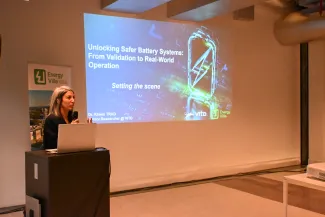
Under the theme Unlocking Safer Battery Systems: From Validation to Real-World Operation, participants exchanged scientific insights, practical experiences and perspectives on the challenges that remain.
From initial testing to continuous monitoring
Battery safety has improved thanks to advances in engineering, manufacturing and operational monitoring. Yet safety cannot be assessed only once. Battery conditions evolve throughout their lifetime, making continuous assessment increasingly important.
The discussions highlighted how battery modelling, physical testing and advanced diagnostics complement each other. Simulations help researchers optimise battery systems, while physical testing provides the evidence needed to assess their safety and reliability.
Testing battery safety at different stages of a battery's life and at different scales remains challenging. This underlines the pivotal role of battery safety testing centres and R&D in safety validation, diagnostics and predictive operation.
Different perspectives, shared responsibilities
One recurring message was the importance of cooperation across the battery value chain. Manufacturers, operators, insurers and emergency services assess risks from different perspectives.
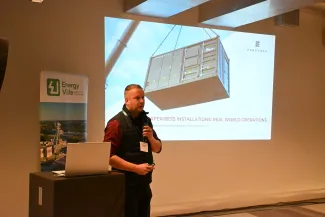
For example, battery energy storage system (BESS) manufacturers primarily focus on safety at system level, while fire services are particularly concerned with the potential impact of incidents on the surrounding environment. Finding appropriate safety measures requires bringing these perspectives together.
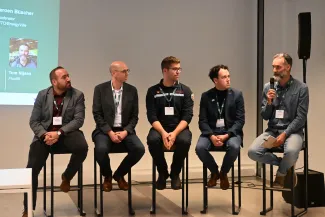
A panel discussion moderated by VITO/EnergyVille's Jeroen Büscher brought together representatives from NIPV, Posetron, Hulpverleningszone Noord-Limburg, Allianz and Flux50 to explore what is still needed to strengthen confidence in battery safety.
Safety must also be addressed at every stage of a battery project, from design and insurability to installation, the installed system, operation and incident response. Identifying the relevant stakeholders and decision-makers at each stage is essential.
Effective safety management therefore requires information sharing, clear responsibilities and close communication, including 24/7 support from BESS operators.
VITO/EnergyVille's collaboration with PLOT and Brandweerzone Oost-Limburg reflects this need to connect battery research and testing expertise with practical emergency response experience.
This partnership is part of VITO/EnergyVille's broader work on battery safety. VITO/EnergyVille also leads Task 49, ‘EV Fire Safety’, within the International Energy Agency's Electric Vehicle Technology Collaboration Programme. The task examines fire safety concerns related to electric vehicles and provides objective information for policymakers, companies and end users.
Remaining challenges and next steps
The symposium also addressed differences in battery safety standards and requirements across regions. Greater harmonisation could support the sector, particularly as large-scale storage expands in densely populated areas.
Practical experiences with battery dismantling, sorting and storage highlighted further challenges in diagnostics for second-life applications, knowledge sharing and training.
The third OMES Symposium underlined the importance of bringing these perspectives together, connecting research, testing and operational experience to support safer battery systems throughout their entire lifetime.