
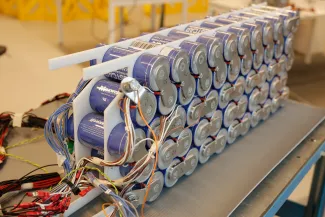
An autonomous battery cell
EnergyVille researchers are working on a new generation of smart, autonomous battery cells. By integrating advanced electronics and built-in intelligence directly into individual cells, batteries can gain real-time insight, self-management, and early fault detection. As a result, battery systems will be safer, more sustainable and more durable.
Today, batteries are mainly managed at battery pack level. Conventional Battery Management Systems monitor voltage, temperature, and state of charge, but often miss the fine detail of what is happening inside each cell individually, for example in terms of performance, ageing, or early defects.
With ABCDE (Advanced Battery Cells with Disruptive Electronics), a project supported by VLAIO and Flux50, EnergyVille researchers aim to address this issue. The project focuses on developing battery cells with built-in sensors, electronics and intelligence. In time, those cells should be able to monitor their own temperature, voltage, and state of charge, run self-diagnostics, detect faults at an early stage and communicate wirelessly with the central control unit of the battery management system.
That opens new possibilities throughout a battery’s lifetime. Safety issues can be detected sooner, because irregularities and defects become visible earlier. Batteries can also last longer, because their condition can be monitored more accurately. And when batteries are replaced or taken out of service, it becomes easier to assess which cells are still suitable for reuse and which should be recycled instead.
Beyond the technological challenge, the project also has the explicit ambition to strengthen the Flemish and European battery value chain, at a time when safety, lifetime, transparency, and circularity are becoming increasingly important.
Why does battery management matter?
A battery pack consists of multiple individual cells, together with electronics, sensors, cooling and a Battery Management System that monitors and controls the whole system. Today, that management system tracks parameters such as temperature, voltage, and state of charge, and ensures that the battery can be charged and discharged safely.
EnergyVille wants to rethink that approach by developing autonomous, sensor-integrated battery cells. By collecting and processing data in real-time, directly at the cell level, batteries can be made safer and their lifetime can be extended.