
Amauri Martins Britto moved from Brazil to Genk to research power cables
Amauri Martins Britto works at EnergyVille/KU Leuven and Etch on a research topic that may sound abstract at first, but becomes highly tangible in practice: the behaviour of underground power cables.
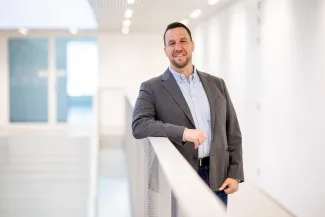
As lead developer of LineCable- Models.jl, he builds computer tools that simulate complex scenarios, from short circuits and lightning strikes to disturbances that can spread through cables across a wider network. The
research is grounded in mathematics and physics, but closely tied to performance, reliability and ultimately safety, both of the infrastructure itself and of the people working on or around it.
Amauri is an electrical engineer by training and moved from Brazil to Belgium nearly two years ago. By then, he had already built a strong career: from field engineer to consultant, entrepreneur and university professor. Still, he felt a growing desire to focus more deeply on research. That search eventually brought him to Genk. “For this position, we took a big step as a family,” he says. “The transition was not straightforward, but professionally I feel
very strongly that this is the right place for me.”
What he values most about EnergyVille is the way different backgrounds, areas of expertise, and institutions
come together. In his view, that proximity accelerates collaboration in a very natural way. “You put people together, and ideas start to emerge almost spontaneously,” he says. “I’ve never seen that before anywhere I worked.” He also appreciates how that collaboration goes beyond formal structures: sometimes it starts with a conversation in the hallway or over lunch, and then grows into something sharper and more useful.
A highlight of 2025 was, without a doubt, the launch of a stable open-source version of the cable toolbox he helped build from scratch. The software is already being used by both researchers and industry partners. “That was a real milestone for me,” Amauri says. “We made something that helps researchers move forward and is also genuinely useful in practice. What’s more satisfying than turning a highly specialised area of research into something accessible and usable for the people who need it?”