
Fact Sheet – Blackout in Spain and Portugal: What Happened on 28 April 2025?
On 28 April 2025, Spain and Portugal were hit by a large-scale blackout. Within seconds, more than 20 GW (> 76%) of total generation capacity went offline, leaving millions without electricity. The incident highlights both the vulnerability and the resilience of Europe’s interconnected power grid. This fact sheet shows what we know, puts the event into context, and discusses the implications for other parts of Europe, including Belgium.
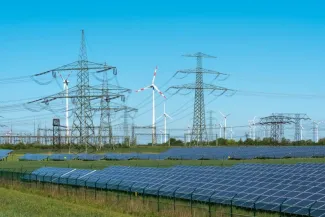
Cause of the major Blackout in Spain and Portugal
The exact cause of the large-scale outage in the Iberian electricity grid is not yet fully clear. Earlier reports about an “exceptional atmospheric phenomenon” have been ruled out, but investigations are still ongoing.
Initial analyses point to a chain reaction of events:
- It all started with a local fault in the Spanish grid, which triggered the shutdown of several solar parks in the region.
- This disrupted the delicate balance of the power system. Normally, the European high-voltage grid operates synchronously at 50 Hz, but due to the incident, the frequency in Spain and Portugal began to deviate from that of other regions.
- This led to slow oscillations in voltage and power (0.1–1 Hz) on top of the 50 Hz base frequency, also called interarea oscillations, which spread rapidly across the network. Within seconds, the Iberian grid began to “fluctuate”, compared to the rest of Europe, effects of which were measurable as far away as Latvia.
- To prevent further damage, the European protection systems automatically intervened: the interconnection between France and the Iberian Peninsula was disconnected. Spain and Portugal were effectively isolated from the rest of Europe.
The result? A massive blackout. Within seconds, an estimated 20 GW of the 26 GW of installed capacity went offline.
Other parts of Europe experienced minor frequency deviations, but these remained within safe operational limits. The Belgian grid was not affected.
Are Large-Scale Power Disturbances Unique?
Such incidents, for example, can occur as a result of natural phenomena such as hurricanes or wildfires. In addition, technical faults – like the simultaneous failure of multiple installations – or human errors can also lead to widespread outages.
Notable famous examples include:
- The two-day large-scale blackouts in India in 2012, affecting 400 and 620 million people respectively.
- A nationwide “medium-sized” blackout in Italy in 2003.
- Several large-scale outages in the United States caused by natural phenomena, for example hurricanes Katrina and Sandy or the wildfires in California.
Could a Similar Blackout Happen in Belgium?
Unlike the Iberian Peninsula, Belgium is highly integrated into the European grid, with robust interconnections to neighboring countries. This makes our system less vulnerable — Belgium can rely on support from its neighbors during disturbances.
In contrast to the Iberian Peninsula, Belgium is much more strongly embedded in the European grid, with robust connections to neighboring countries. This makes our system less vulnerable: Belgium can more easily rely on support from its neighbors in case of problems. However, that doesn’t mean a large-scale outage is impossible.
The last blackout in our country dates back to August 1982. During the winters of 2014–2015 and 2018–2019, there were concerns about possible outages, but of a different nature. At that time, the fears of electricity shortages in winter were due to an accelerated phase-out of coal and nuclear power plants. Deliberately disconnecting a part of the load in a controlled manner was considered, but it was never implemented.
The strong interconnection with our neighboring countries also has a downside: if a serious incident were to occur in Belgium, there’s a chance that other parts of Europe would also be affected, precisely because of the interconnected nature of our networks.
Under normal conditions, the European grid is exceptionally stable: it can typically withstand the loss of one or more components. Yet no system can offer absolute security against every possible incident. That’s neither technically nor economically feasible — nor desirable. The focus today is therefore on resilience: the ability to restart our grids quickly and safely, and to limit the impact of failures by temporarily isolating parts of the network.
Why Spain and Portugal Are Particularly Vulnerable
The Iberian Peninsula is less strongly connected to the rest of Europe — partly because the Pyrenees make interconnection with France more difficult. As a result, it makes the region prone to becoming a “network island” during major disturbances.
Spain and Portugal’s interconnection capacity (the amount of electricity that can be exchanged across borders between countries) is only around 10% of their total demand (2–3% of installed capacity). That means they can only import or export limited amounts of power, making their grids more likely to be isolated in case of a fault.
For comparison: the European Union has set a target of at least 15% interconnection capacity by 2030, to strengthen energy security between member states and to improve how efficient renewable energy is being used.
How Does a Power Grid Restart After a Blackout?
A blackout like the one in Spain and Portugal shows how dependent our society is on electrical energy. As soon as the power goes out, public life comes to a complete standstill: elevators, lighting, traffic (including traffic lights, trains, metros, and air travel), communication, payment systems, industry, and even healthcare are severely affected.
Panic can break out, so a quick and controlled restart of the grid is crucial.
For this, detailed procedures exist to ensure that the electricity grid is brought back online safely and step by step. This process takes place in several phases:
- First, the transmission network,
- Then, the rest.
Each step is carefully calibrated to ensure that supply and demand remain balanced. Operators often work remotely, sometimes with limited communication or incomplete system data, and may need to manually intervene — all of which takes time.
So it’’s a delicate process.
But in most cases, the majority of users are reconnected within a few hours. Remote areas or grids with physical damage may have to wait longer.
Renewable Energy: Strength or Weakness?
The growing share of renewable energy (wind and solar) makes grid management more complex. These sources often consist of many smaller units that contribute little to the electricity grid’s “inertia” — the built-in slowness needed to keep frequency stable during sudden changes in supply or demand. With less inertia, frequency fluctuates more quickly and strongly during disturbances, making the grid more sensitive to disruptions.
At the same time, renewables bring important advantages:
- Modern renewable installations can actively support frequency regulation.
- There are more small-scale installations, which reduces the impact of a single fault.
- When a restart is needed, some renewable installation can help (semi-)autonomously
The energy transition therefore requires thorough adjustments to grid design and management, and during this transition, more operational incidents are to be expected.
The Importance of Grid Stability in an Interconnected, Renewable-Based Europe
Europe’s grid is robust and well-designed. Yet the blackout in Spain and Portugal on 28 April 2025, serves as a reminder: even advanced systems remain vulnerable.
For Belgium and the rest of Europe, this is a wake-up call: absolute security does not exist, but with smart investments in stability and strong cooperation, we can limit risks and recover faster when failures occur.
Investing in a stronger and more robust grid remains crucial. Key focus areas include:
- increasing interconnection capacity,
- enhancing grid stability mechanisms and control systems,
- clear procedures for containing large-scale incidents and restarting affected regions.
Etch, our recently established Energy Transmission Competence Hub, with support of the Flemish Government, is conducting pioneering research into future-proof electricity networks. Read all about this groundbreaking research on our website!